B: Emergency & Storms
Monsoon Flash Flood Yard Damage: Diverting Desert Storm Runoff
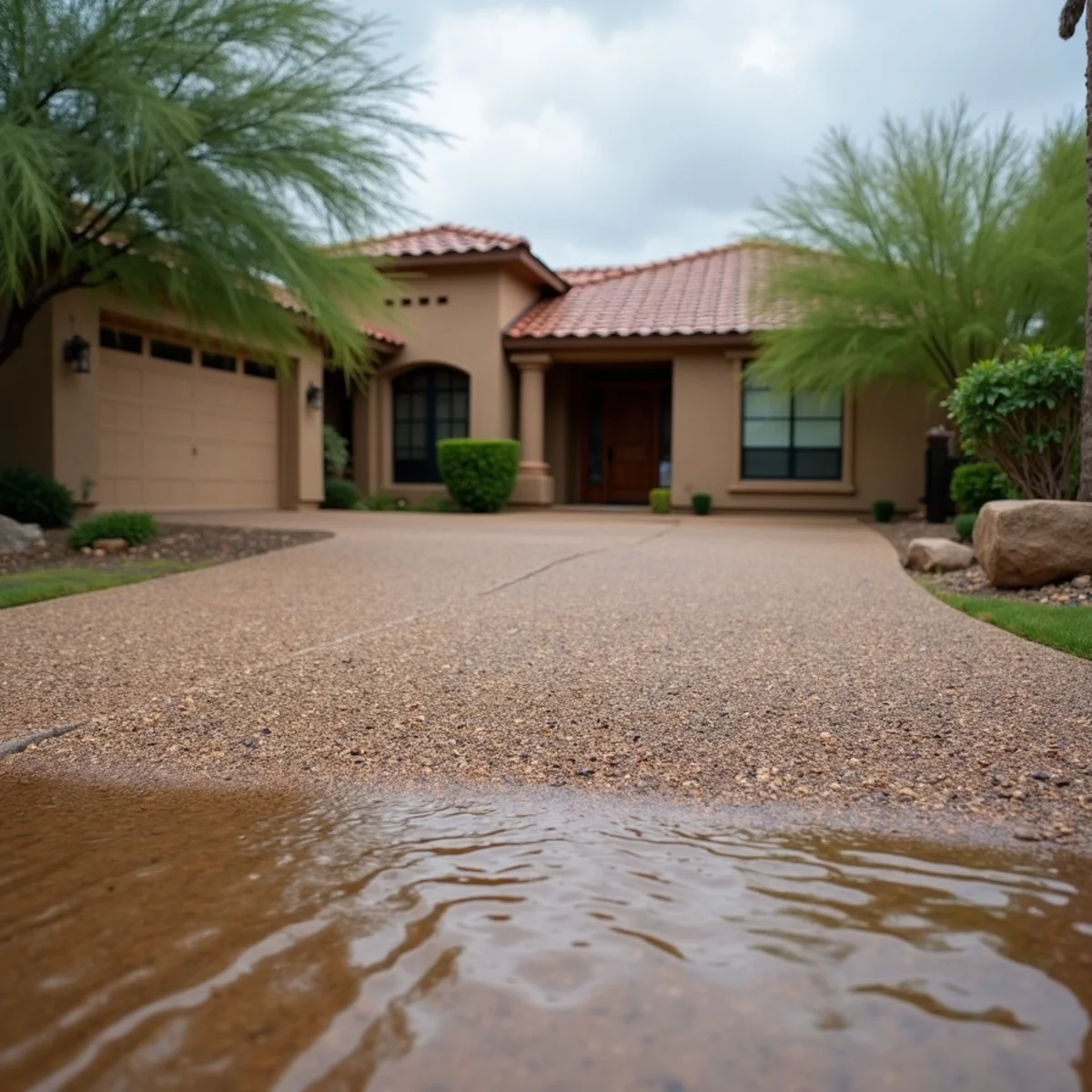
Why baked desert soil sheds monsoon rain like concrete, and how dry creek beds, catch basins, and correct grading redirect flash-flood runoff away from your foundation.
Desert rain does not soak in; it runs. A single monsoon cell can drop an inch of water in under an hour onto ground that behaves like pavement, and all that water has to go somewhere. Too often it goes across your decomposed granite, under your patio, and up against your stucco. This guide explains why it happens and the drainage strategies that actually control it.
Why Baked Desert Soil Repels Rainwater Like Concrete
Sonoran Desert ground is dry, compacted, and often crusted, and much of it sits over caliche, a nearly impermeable hardpan. When intense rain hits, the soil cannot absorb it fast enough, so infiltration stalls and the water sheets across the surface. This flash runoff is why a yard that looks fine for eleven months can be gouged out in a single July storm. The problem is not too much rain overall; it is too much rain too fast on ground that cannot take it in.
There is a counterintuitive twist that makes the first storms of the season the worst. Very dry desert soil can turn temporarily water-repellent, so the opening downpour of the monsoon runs off almost entirely rather than soaking in. On top of that, a typical Valley lot has been graded, compacted, and covered in rock during construction, all of which reduce whatever little natural absorption the ground once had. The water that used to spread out across open desert now concentrates on a small lot with a house, a pool, and hardscape all shedding water of their own.
Signs Your Drainage Is Failing
Damage from poor drainage is cumulative, so catching the early signs lets you fix it before a major storm forces the issue. Watch for these after any significant rain:
- Decomposed granite washed into driveways, sidewalks, or the street after storms.
- Standing water that lingers for hours against the house or in low spots.
- Eroded channels or bare, scoured tracks where water clearly ran.
- Settling or gaps appearing at the edges of patios, walkways, or walls.
- Mud lines or water staining on stucco near the base of exterior walls.
How Flash Flooding Washes Away Decomposed Granite and Undermines Patios
Fast-moving water is astonishingly good at moving small rock. Loose decomposed granite is light enough to float and roll, so a strong sheet flow strips it off beds and piles it in driveways and gutters. Worse, water that runs along the edge of a patio or wall finds any gap and scours the base material out from underneath, undermining the slab or pavers. Once the base is compromised, settling and cracking follow. Repairing that damage often means resetting hardscape and replacing lost rock, work our decomposed granite and rock landscaping crew handles as part of storm recovery.
Designing Dry Creek Beds with Riprap Rock to Channel Torrential Water
A dry creek bed is the desert's most elegant drainage tool: a shallow, rock-lined channel that stays a decorative landscape feature when dry and becomes a controlled waterway during a storm. Built correctly, it collects sheet flow and carries it along a planned route to a safe discharge point instead of letting water wander wherever it wants.
- A compacted, graded channel sized for the volume it must carry.
- Larger riprap and cobble to armor the bed against erosion at high flow.
- Geotextile fabric beneath the rock to keep soil from washing out from below.
- A defined inlet and a safe outlet that directs water to the street or a drainage easement, never toward a neighbor or your own foundation.
Installing Catch Basins and Pop-Up Emitters Near Foundation Walls
Where water pools in a low spot or against a wall, a catch basin gives it somewhere to go. The basin collects runoff through a grate and feeds it into buried piping that carries it away, often surfacing at a pop-up emitter out in the yard or at the curb. This is the right fix for courtyards, side yards, and any area where grading alone cannot move the water. Pairing catch basins with a dry creek bed handles both the concentrated pooling and the broad sheet flow. Our monsoon flooding yard drainage repair service designs these systems for the specific way water moves across your lot.
Sizing and outlet placement are what make a catch basin system work. An undersized basin or a pipe that runs uphill simply backs up during the storm it was meant to handle, and an outlet that dumps toward the house, a neighbor, or a spot with no path to leave only relocates the problem. A good design routes water to a legal, safe discharge, typically the street or a drainage easement, with pipe sized for the volume and enough fall to keep it flowing. Cleanouts and accessible grates matter too, because a drain packed with silt and debris is no drain at all, and desert storms carry a lot of both.
Protecting Slopes and Retaining Walls from Washout
On lots with any grade, moving water does its worst damage where the slope steepens or a retaining wall holds back soil. Fast runoff scours the toe of a slope and works behind walls that lack proper drainage, and the pressure of saturated soil, called hydrostatic pressure, is what pushes retaining walls out of plumb and eventually topples them. The fixes are specific: weep holes and gravel backfill so water can escape from behind a wall, riprap or planted stabilization on the slope face, and a graded channel that carries water down the grade in a controlled path rather than letting it sheet across and undercut everything. Where a wall is already leaning or a slope has begun to fail, our retaining wall and erosion shoring service stabilizes it before the next storm makes it worse.
Grading Away from Stucco Walls to Prevent Desert Termite Moisture
The most fundamental rule of drainage is that soil should slope away from the house. Over years, rock beds settle and grading flattens, so water starts draining toward the foundation instead of away from it. Standing moisture against stucco and slab edges invites problems, including the conditions that attract subterranean termites, which are common across the Valley. Re-establishing positive slope away from all walls, generally a fall of several inches over the first several feet, is often the highest-value drainage correction on the whole property.
Small details around the house compound the problem or fix it. Downspouts that dump right at the foundation should be extended out past the planting beds. Rock beds piled above the stucco weep screed trap moisture against the wall and should be kept below it. And any irrigation running near the foundation should be checked, since a leaking line adds constant moisture that mimics a drainage failure. Getting grade, downspouts, and irrigation all pulling water away from the structure is the unglamorous foundation of a dry, stable yard.
Contact Our Crew for Post-Monsoon Landscape Reconstruction
After a major storm we handle the full recovery: clearing debris, resetting undermined hardscape, replacing washed-out granite, and installing the drainage that keeps it from happening again. We work throughout the flood-prone parts of the East Valley, including Apache Junction, Fountain Hills, and Mesa, and we are locally owned, licensed, and insured.
If monsoon runoff is damaging your yard or reaching your foundation, call Ecosphere Landscaping at (323) 606-0255 for a drainage assessment and post-storm reconstruction.
Talk to a local desert landscaping expert
Serving Mesa & the East Valley since 2017. Get honest, itemized pricing and water-smart advice for your specific yard.
Frequently asked questions
Dry, compacted desert soil over caliche cannot absorb intense rain fast enough, so water sheets across the surface as flash runoff. The fix is managing that runoff with grading, dry creek beds, and catch basins, not trying to make the soil absorb it.
It is a rock-lined channel that looks decorative when dry and channels storm runoff to a safe outlet when it rains. Built with proper grading, riprap, and fabric, it is one of the most effective and attractive desert drainage tools.
Yes. Moisture against the foundation and stucco can cause damage and attract subterranean termites. Re-establishing positive grade that slopes away from all walls is usually the most important drainage correction.
Yes. We reset undermined hardscape and replace lost decomposed granite as part of storm recovery, then install drainage so future runoff is channeled away rather than stripping the rock again.
Related services & areas
Service areas