B: Emergency & Storms
Emergency Leaning Saguaro: Saving Storm-Damaged Giant Cacti
A leaning saguaro is a multi-ton safety hazard, not just a plant problem. Why saturated caliche tips them, how emergency bracing works, and when removal is the only safe call.
A saguaro that has started to lean after a storm is one of the most serious hazards a desert yard can present. These are not shrubs; a mature saguaro can weigh several tons, and when one goes over it can crush a car, a wall, or a person. If a large cactus near your home is tilting, keep people well clear and treat it as an emergency. This guide explains why it happens and what can, and cannot, be done.
Why Saturated Caliche Soil Causes Heavy Saguaros to Tip Over
Saguaros anchor with a shallow, wide network of roots plus a central taproot, a system tuned for a landscape that is dry most of the year. Monsoon downpours saturate the soil, and where caliche traps that water in the root zone, the ground turns soft and loses its grip. A top-heavy, water-swollen saguaro, its tissue engorged after soaking up the rain, then leans under its own weight or the push of a microburst. The same wet-caliche mechanism that topples desert trees is even more dangerous under a multi-ton cactus.
A saguaro is essentially a giant water tank. Its pleated, accordion-like body expands to store hundreds of pounds of water during the rains, and that stored water is precisely what makes a leaning specimen so heavy and so quick to pass the tipping point. Landscape irrigation adds to the risk: a saguaro planted in a watered bed, or downhill from a lawn or drip zone, sits in soil that stays wetter than the desert it evolved for. Overwatering not only softens the anchorage, it also feeds the internal rot that weakens the plant from the inside.
Warning Signs Before a Saguaro Falls
A saguaro rarely goes from vertical to horizontal without warning. Catching the early signals can be the difference between a stabilization and a collapse:
- Any new lean, even a few degrees off vertical, especially after heavy rain.
- Soil heaving, cracking, or pulling away from the base on one side.
- A soft, spongy feel at the base or lower trunk instead of firm tissue.
- Dark, wet, or foul-smelling lesions on the skin, a sign of bacterial necrosis.
- Arms or the trunk looking shrunken or discolored, hinting at internal rot.
The Danger of Collapse: A Mature Saguaro Weighs Several Tons
The reason a leaning saguaro is treated as a critical emergency rather than a gardening task comes down to physics and biology:
- A large, hydrated saguaro can weigh several tons, enough to destroy whatever it lands on.
- The trunk is a rigid, water-filled column with no give; once past the tipping point it falls fast.
- The plant is covered in long, sharp spines, making any hands-on approach hazardous.
- Cutting or roping a leaning saguaro incorrectly can trigger an uncontrolled collapse.
- Its center of mass sits high in the arms and upper trunk, so the lean accelerates as it grows.
Treat the area beneath and around a leaning saguaro as a fall zone and keep it clear of people, pets, and vehicles until a professional has evaluated it. A cactus that has held a slight lean for a day can pass its tipping point in the next gust or the next round of rain, and there is no safe way to predict the exact moment. Moving a parked car and rerouting foot traffic costs nothing and removes the worst-case outcome while you wait for an assessment.
Emergency Bracing Protocols: Timber Supports and Tension Straps
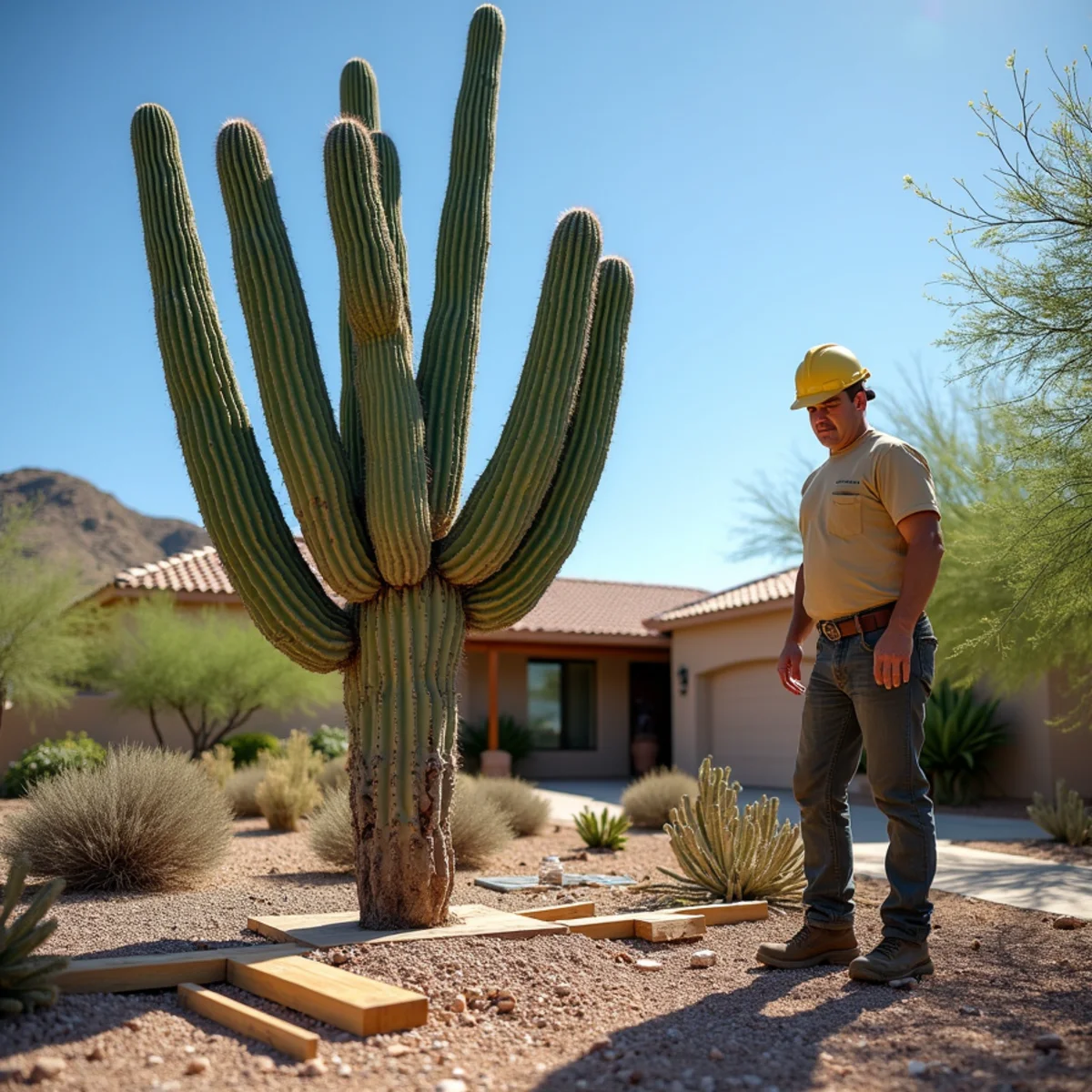
When a saguaro is worth saving and the lean is caught early, professionals can stabilize it with engineered bracing while the situation is assessed and the soil dries. This is specialized work: padded timber supports and tensioned straps are positioned to hold the trunk without cutting into the skin, spreading the load so the bracing does not itself wound the plant. Bracing buys time to evaluate the roots and decide whether re-straightening is realistic, but it is a controlled intervention, not a permanent fix on its own.
Why not just prop it and forget it? Because the skin of a saguaro is thin and easily wounded, and any support that bears directly on it creates an entry point for the same bacterial infection that kills leaning cacti. Proper bracing uses wide, padded contact points and distributes the weight across braces set at the correct angles, and it is checked and adjusted as the plant and soil respond. Done casually with a bare board and a rope, a rescue attempt often does more harm than the lean itself.
Assessing Root Rot and Bacterial Necrosis in Leaning Cacti
The lean is often a symptom of what is happening below and inside. Prolonged wet soil can cause root rot, and bacterial necrosis can invade the trunk, showing as dark, oozing, foul-smelling lesions. A saguaro that leaned simply because the soil softened around otherwise healthy roots has a far better prognosis than one whose base is already rotting. Assessing root integrity and checking for necrosis is what determines whether a cactus can be re-anchored or must be removed before it fails or spreads disease.
Necrosis is also a reason not to delay. Bacterial necrosis can spread within a stressed plant and, left untreated, can move to other cacti nearby. Isolating and assessing an infected saguaro promptly protects the rest of a desert planting, which is one more reason a leaning, oozing cactus is a call to make today rather than next week.
Safe Removal vs Professional Re-Straightening and Re-Anchoring
Two outcomes are possible. If the roots are sound and the lean was caught early, a crew can carefully re-straighten and re-anchor the saguaro, then brace it while the roots re-establish. If the roots have rotted, the trunk shows necrosis, or the lean threatens people or structures, safe removal is the responsible choice, done in a controlled sequence so the heavy trunk comes down without harm. A healthy specimen that must come out can sometimes be relocated rather than destroyed; our native cacti and desert botanical plantings team can advise on salvage and replacement.
After the Emergency: Replanting and Prevention
Once the immediate hazard is handled, a little foresight keeps the next monsoon from repeating the crisis. Saguaros and other large cacti do best planted in well-draining native soil, on slightly raised ground rather than a low spot that collects water, and away from lawn or drip zones that keep the root area constantly wet. A newly set or re-anchored saguaro needs firm support and minimal watering while it re-establishes, and it should be oriented to the same sun exposure it had before, since the skin can sunburn on a side that was previously shaded.
If you are replacing a lost specimen, right-sizing matters. A very large saguaro is spectacular but extremely heavy to establish and slow to re-anchor, while a moderately sized, healthy plant settles in faster and stands a better chance of long-term stability. Whatever the size, planting it correctly the first time, with attention to drainage and anchoring, is the real prevention against another emergency down the road.
Call Ecosphere Landscaping for Immediate Saguaro Assessment
Time matters with a leaning saguaro; every day of continued lean and wet soil lowers the odds of saving it and raises the collapse risk. Ecosphere Landscaping is locally owned, licensed, and insured, and we respond to cactus emergencies across Scottsdale, Paradise Valley, and Mesa.
If a saguaro or other large cactus is leaning near your home, keep everyone clear and call us immediately at (323) 606-0255 for an emergency assessment.
Talk to a local desert landscaping expert
Serving Mesa & the East Valley since 2017. Get honest, itemized pricing and water-smart advice for your specific yard.
Frequently asked questions
Heavy rain saturates the shallow root zone, and where caliche traps that water the soil softens and loses its grip. A top-heavy, water-swollen saguaro then leans under its own weight or a microburst. It is a safety emergency because a mature saguaro weighs several tons.
Sometimes. If the roots are sound and the lean is caught early, professionals can brace, re-straighten, and re-anchor it. If the roots have rotted or the trunk shows necrosis, removal is the safe choice. A prompt assessment decides which.
No. A leaning multi-ton cactus is under enormous load and covered in spines. Attempting to push, rope, or prop it can trigger an uncontrolled collapse. Keep the area clear and call a crew equipped for hazardous cactus work.
Saguaros are protected under the Arizona Native Plant Law, and removal or relocation can involve permitting through the Arizona Department of Agriculture. A professional can handle the assessment and keep the work compliant.
Related services & areas
Service areas