E: DIY vs Pro
DIY Desert Tree Trimming Mistakes That Cause Monsoon Blow-Overs
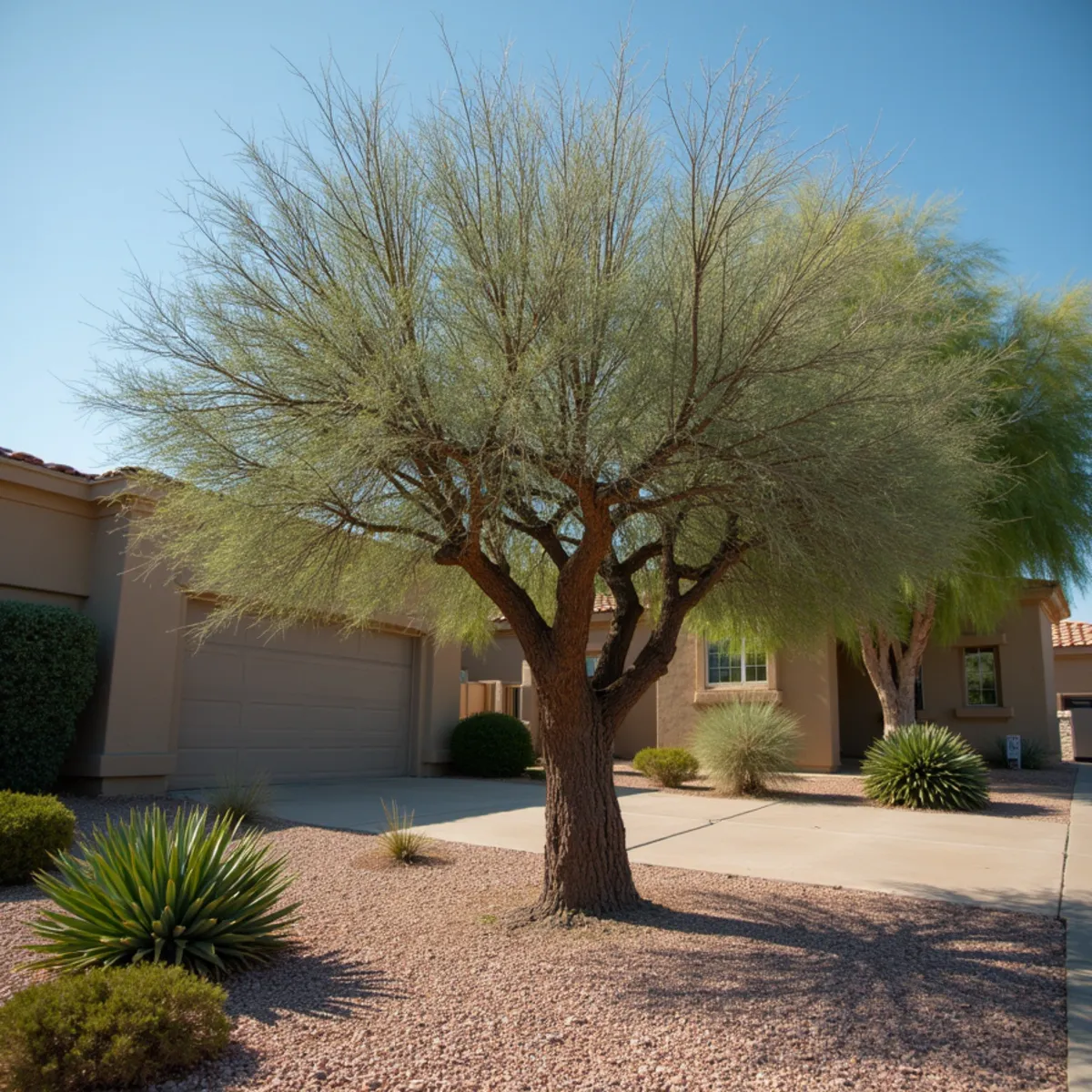
The way you prune a desert tree decides whether it survives the monsoon. These four common DIY mistakes are why palo verdes and mesquites topple every summer.
After every big monsoon microburst, the same call comes in: a tree is down, across a driveway, a fence, or a roof. When we look at the failures, most were not simply unlucky — they were pruned in ways that guaranteed the blow-over. Good pruning makes a desert tree more wind-resistant; bad pruning makes it a liability. Here are the four mistakes we see most, and why each one sets a tree up to fail when the 60-plus-mph winds arrive.
Mistake 1: 'Lion-Tailing' (Stripping Inner Branches and Weighting Tips)
Lion-tailing is the most common and most damaging mistake in the Valley. It means stripping out all the interior branches and foliage so the growth sits only at the ends of the limbs, like a tuft on a lion's tail. It looks tidy for a week, but it is structurally disastrous: all the weight is now at the far end of long, bare limbs, the tree loses the interior growth that dissipates wind, and each limb becomes a lever waiting to snap. Wind that a properly thinned tree would filter through hits a lion-tailed tree like a paddle. This single mistake causes more monsoon limb failures than any other.
Lion-tailing hurts the tree in slower ways too. Interior foliage is where a lot of the tree's food production happens, and stripping it starves the limb and forces a stress response. The suddenly exposed inner bark can sunburn, and the long bare limbs often respond by throwing out weak sprouts along their length. Crews do it because it is fast and gives a dramatic 'cleaned up' look that some homeowners ask for by name — which is exactly why you should be wary if that is what you are sold.
Mistake 2: Topping Desert Trees (Creating Weak Water Sprouts That Snap)
Topping — cutting the main leaders back to stubs to reduce height — is one of the worst things you can do to any tree. The tree responds to the shock by throwing out a dense flush of fast-growing water sprouts from the cut points. These sprouts are weakly attached, grow quickly, and become heavy and top-heavy within a season or two. They snap in wind far more readily than natural limbs, and the large topping wounds invite decay into the trunk. A topped tree is more dangerous, not less, and it never regains a sound structure.
If a tree has genuinely outgrown its space, the answer is not topping but proper reduction pruning, which shortens limbs back to a suitable lateral branch that can take over as the new leader. Done correctly, that lowers height while keeping a natural form and sound attachments. It is slower and takes more skill than lopping off the top, which is precisely why cheap crews avoid it. A tree that has already been topped can sometimes be rehabilitated over several years by selecting and training the strongest sprouts, but prevention is far easier than the cure.
Mistake 3: Trimming Too Close to Monsoon Season Without Root Watering
Timing and hydration matter. Heavy pruning right before or during monsoon season stresses a tree at the worst possible moment, and a tree with a dry, shallow root system has nothing anchoring it when the wind loads the canopy. The pairing that topples trees is a heavy canopy over shallow roots grown from frequent, shallow watering. Deep, infrequent irrigation drives roots down and anchors the tree; structural pruning should be done to prepare the canopy before the season, not hacked at once storms are already rolling through.
The ideal cadence in the Valley is to do the significant structural work in late winter or early spring, well ahead of the June-to-September monsoon, so the tree heads into storm season already balanced and can seal its cuts while it is growing actively. Light touch-ups can happen through the year, but if a tree only ever gets attention in a pre-storm panic, it never develops sound structure. Consistent, correctly timed care over several seasons is what produces a tree that stands up to a microburst rather than one pruned reactively the week a storm is forecast.
Mistake 4: Damaging the Protective Green Bark of Palo Verde Trees
Palo verde is unusual: its green bark photosynthesizes, so the trunk and branches are working tissue, not just structure. Careless trimming that scrapes, gouges, or sunburns that green bark — or over-thinning that suddenly exposes previously shaded bark to full sun — injures the tree and opens the door to borers and disease. Flush cuts that remove the branch collar do the same on any species, destroying the tree's ability to seal the wound. Clean cuts at the right point, leaving the collar intact, are what let a tree wall off damage and stay healthy.
Tool hygiene and cut size round out the damage risks. Dirty blades spread pathogens from one tree to the next, and oversized cuts on mature wood may never fully close, leaving a permanent entry point for decay. A good rule is to remove no more than about a quarter of the live canopy in a single year and to keep individual cuts modest, so the tree can seal each wound and keep enough foliage to feed itself. Push past that and even technically correct cuts add up to a stressed, vulnerable tree.
How Proper Crown Thinning Saves Trees from 70 MPH Microbursts
Done to the ANSI A300 standard, crown thinning removes a modest, evenly distributed portion of the canopy so wind passes through rather than pushing against a solid mass. It keeps weight close to the trunk, preserves the interior structure, respects the branch collar, and leaves the tree balanced. A tree thinned this way flexes and sheds wind in a microburst instead of catching it like a sail. This is skilled work, and it is the core of our desert tree crown thinning service — the difference between a tree that survives a 70-mph gust and one that ends up on your roof.
Proper thinning also addresses the tree's architecture, not just its density. A trained eye looks for co-dominant leaders and narrow, included branch unions — the weak forks where a limb is most likely to split — and corrects them while the tree is young enough to respond. It removes crossing and rubbing branches, deadwood, and stubs, and it establishes good spacing between scaffold limbs. That structural work, repeated over a few seasons, builds a tree that is fundamentally sound, which no amount of last-minute trimming can replicate on a tree that was allowed to grow up unbalanced.
Trust Licensed Desert Tree Trimmers at Ecosphere Landscaping
If a storm has already brought a tree or a heavy limb down, our emergency monsoon storm damage cleanup crew responds quickly to clear and make the site safe. Better still, let us thin your trees correctly before the season so it never comes to that. We serve Mesa, Scottsdale, and Tempe.
When you hire a crew, ask a few questions that separate skilled arborists from someone with a truck and a chainsaw. Do they prune to the ANSI A300 standard? Will they avoid lion-tailing and topping? How much of the canopy do they plan to remove, and why? A knowledgeable crew will happily explain their approach and talk you out of the very cuts that cause blow-overs. If a bid promises to make your tree dramatically smaller or thinner in one visit, treat it as a warning sign, not a bargain.
Ecosphere Landscaping is a locally owned, licensed, and insured family business founded in 2017, and our crews prune to recognized arboriculture standards. Call us at (323) 606-0255 to get your desert trees monsoon-ready.
Talk to a local desert landscaping expert
Serving Mesa & the East Valley since 2017. Get honest, itemized pricing and water-smart advice for your specific yard.
Frequently asked questions
Lion-tailing strips a tree's interior branches so growth sits only at the limb tips. It concentrates weight at the ends, removes the interior structure that dissipates wind, and turns each limb into a lever that snaps in monsoon gusts.
No. Topping triggers weakly attached water sprouts that grow fast, become top-heavy, and snap easily, while the large wounds invite decay. A topped tree is more hazardous and never regains sound structure.
Do structural crown thinning in the cooler months before monsoon, not during it. Heavy pruning mid-season stresses the tree, and a balanced canopy needs to be established over a deep, well-watered root system beforehand.
Palo verde has green bark that photosynthesizes, so the trunk and branches are living, working tissue. Scraping, gouging, or suddenly sun-exposing that bark injures the tree and invites borers and disease.
Proper ANSI A300 thinning removes an evenly distributed portion of the canopy so wind passes through instead of pushing a solid mass. It keeps weight near the trunk and lets the tree flex rather than catch the wind like a sail.
Related services & areas
Service areas