E: DIY vs Pro
Why DIY Weed Spraying Fails in Arizona Summer Heat
You sprayed the weeds and they shrugged it off. In Arizona summer heat, DIY herbicide often evaporates before it works. Here is what actually controls desert weeds.
You mixed the herbicide, soaked the weeds on a blazing July afternoon, and a week later they are still standing — or worse, your prized agave nearby is now yellowing. DIY weed spraying fails constantly in the desert, and not because the product is bad. It fails because of heat, timing, and technique that the label on a big-box jug never explains. Understanding why is the difference between a clean yard and a summer-long losing battle.
The frustration is real, and it is nearly universal among East Valley homeowners who take on their own weeds. The store shelf is full of confident promises, the jug is not cheap, and yet the results rarely match the label. The good news is that the reasons are specific and fixable once you understand them. The bad news is that most of them run counter to what the packaging implies, which is why so much money and effort goes into spraying that the desert simply undoes.
Chemical Evaporation: Why Herbicide Vapors Dissipate Above 90°F
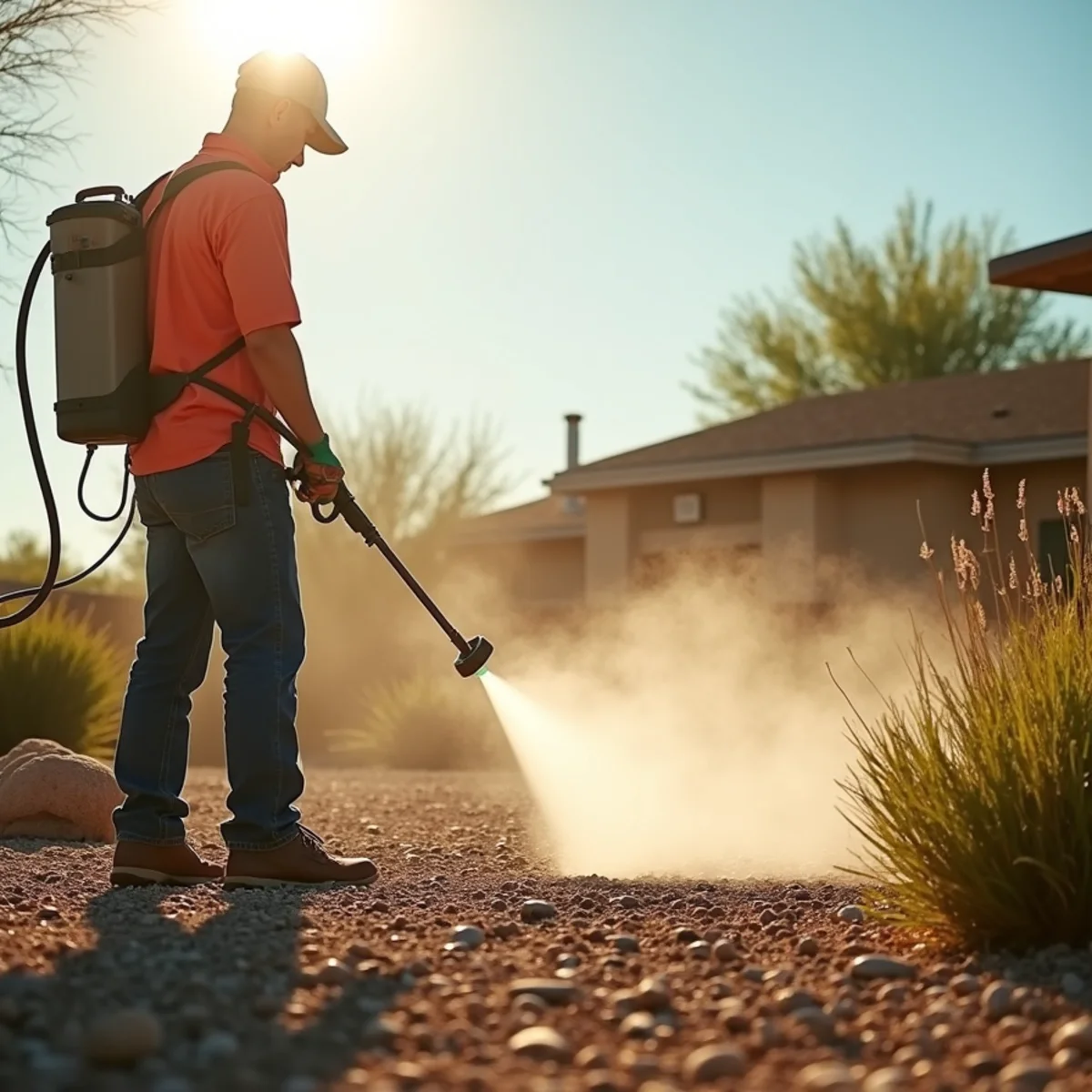
Post-emergent herbicides work by being absorbed into the plant and translocated to the roots, a process that takes hours of contact. In extreme heat, two things sabotage that. The spray droplets evaporate off the leaf before the plant can absorb a meaningful dose, and some herbicides are prone to volatilization above roughly 85 to 90°F, meaning the active ingredient turns to vapor and drifts away — sometimes onto plants you did not mean to hit. Spraying at 108°F in the afternoon sun is close to spraying water. Early morning, when it is cooler and the air is still, is the only sane window in summer, and even then heat limits results.
Heat-stressed weeds fight back in another way, too. When a plant is baking and short on water, it partially shuts down, slowing the internal transport that a systemic herbicide relies on to reach the roots. So even the dose that does get absorbed moves sluggishly and often fails to kill the whole plant, leaving the roots alive to regrow. A weed actively growing in mild conditions takes up and moves herbicide efficiently; the same weed at 110°F is essentially in survival mode and largely ignores it.
The Critical Role of Pre-Emergents Before Winter and Summer Rains
The biggest reason DIY weed control fails is that people only react to weeds they can already see. By then a post-emergent is your only tool, and in heat it is a weak one. The professional approach is prevention: a pre-emergent herbicide applied and watered in before the seeds germinate, forming a barrier that stops the next flush entirely. In the Valley that means treating ahead of the fall and winter weed season and again ahead of spring. Get the pre-emergent right and you barely need to spray anything in the heat, because the weeds never come up.
Timing the pre-emergent to the season is the whole game. A late-summer application before the winter weeds germinate, and a late-winter application before the spring and monsoon flush, catch the two big germination windows in the Sonoran Desert. Apply too late, after seeds have already sprouted, and the barrier does nothing to weeds that are already up. This is why a scheduled program beats sporadic spraying: it puts the treatment down on the calendar, ahead of the weeds, rather than chasing them once they appear.
Accidental Overspray: Killing Expensive Specimen Agaves and Shrubs
Non-selective herbicides do not know the difference between a weed and the agave you paid good money for. On a breezy day, or in heat that drives volatilization, drift settles on nearby desirable plants and shows up days later as yellowing, scorching, or dieback. We regularly see homeowners lose specimen agaves, young trees, and ornamental shrubs to overspray they never noticed at the time. Around valuable plantings, precise application and the right product matter enormously, and this is one place DIY mistakes get expensive fast.
Root uptake makes it worse than it looks. Some herbicides are absorbed through the soil, so spraying weeds growing right at the base of a prized shrub or under a tree's canopy can carry the chemical to the very plant you are trying to protect. The damage often does not appear for weeks, by which point the cause is easy to miss and the plant may be beyond saving. This is why professionals shield desirable plants, choose products carefully near them, and often hand-pull rather than spray in tight quarters around specimen plantings.
Surfactants and Soil Penetrants: Breaking Desert Dust Barriers
Desert weeds are often coated in fine dust and many have waxy or hairy leaves, both of which cause spray to bead up and roll off instead of sticking and absorbing. Professional applications include surfactants — additives that break surface tension so the herbicide actually wets the leaf and penetrates — and, for pre-emergents, proper watering-in so the product reaches the soil zone where seeds germinate. Most consumer ready-to-use products skip or skimp on these, which is another quiet reason the DIY spray does not take.
Water quality quietly sabotages DIY mixes as well. Much of the Valley's tap water is hard and alkaline, and the minerals in it can bind up or degrade some herbicide active ingredients before they ever reach the weed, weakening the dose in the tank. Professionals account for this with water conditioners and correct mixing order, and they match the product to the weed rather than reaching for one all-purpose jug. The gap between a calibrated professional application and a guessed home mix is not one variable — it is half a dozen small ones stacking up.
Legal Safety Standards for Commercial-Grade Herbicide Applications
Commercial-grade herbicides and application at scale are regulated for good reason, and licensed applicators are trained in product selection, mixing rates, drift control, and safe handling. That training protects your plants, your family, your pets, and your neighbors' yards. It also means the products are matched correctly to the weed and the season rather than to whatever was on the store shelf. Doing it right is as much about safety and precision as it is about killing weeds.
There is a real cost to getting it wrong beyond wasted product. Over-application can leave residues that stunt future plantings, contaminate runoff that reaches storm drains, and, in a rock yard, persist far longer than on a living lawn. Under-application breeds tolerance in the weed population. Licensed applicators calibrate rates to the label and the conditions precisely to avoid both extremes, which is something a guessed pour from a jug into a hose sprayer cannot match.
Sign Up for Guaranteed Bi-Annual Weed Control with Ecosphere
The reliable way off the weed treadmill is a scheduled program built around prevention. Our commercial and HOA desert grounds maintenance service applies well-timed pre-emergents, spot-treats breakthroughs in the cool of the morning, and keeps your rock beds clean, and it pairs naturally with a decomposed granite and rock landscaping refresh to remove the silt seed bed weeds rely on. We serve Mesa, Chandler, and Sun Lakes.
A program approach also compounds over time. Because each properly timed pre-emergent cycle prevents that season's weeds from ever setting seed, the seed bank in your granite steadily shrinks year over year, and the yard needs less intervention the longer the program runs. Homeowners who try to spray their way out of weeds each summer stay stuck on the same treadmill; those on a prevention schedule watch the problem fade into the background. That is the difference between fighting weeds and simply not having them.
Ecosphere Landscaping is a locally owned, licensed, and insured family business founded in 2017. Stop wasting summer afternoons spraying weeds that shrug it off — call us at (323) 606-0255 to set up a weed control program that actually works.
Talk to a local desert landscaping expert
Serving Mesa & the East Valley since 2017. Get honest, itemized pricing and water-smart advice for your specific yard.
Frequently asked questions
Above roughly 90°F, spray droplets evaporate off the leaf before the weed can absorb them, and some herbicides volatilize into vapor and drift away. Spraying in extreme afternoon heat is nearly as ineffective as spraying water.
Early morning, when it is cooler and the air is calm. Even then, heat limits results, which is why prevention with pre-emergents beats trying to spray established weeds in summer.
Pre-emergents create a barrier that stops seeds from developing before weeds ever appear. Timed ahead of the fall and spring weed seasons and watered in, they prevent the flush so you rarely need to spray in the heat.
Yes. Non-selective herbicides drift in wind and heat and settle on desirable plants, causing yellowing and dieback days later. Homeowners regularly lose specimen agaves and shrubs to unnoticed overspray.
Desert weeds are often dusty or have waxy, hairy leaves. Without a surfactant to break surface tension, the spray beads and rolls off instead of wetting the leaf and being absorbed.
Related services & areas
Service areas