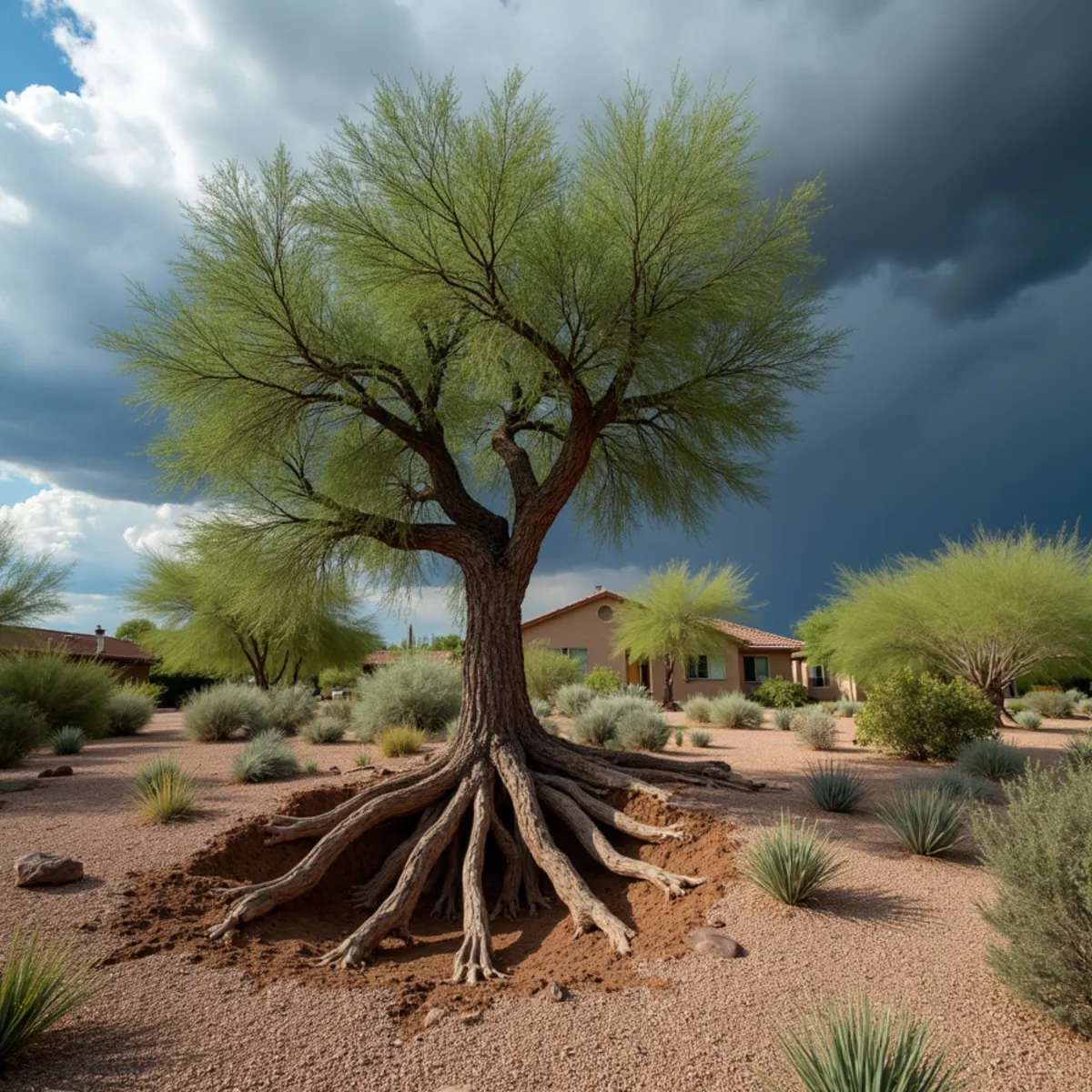
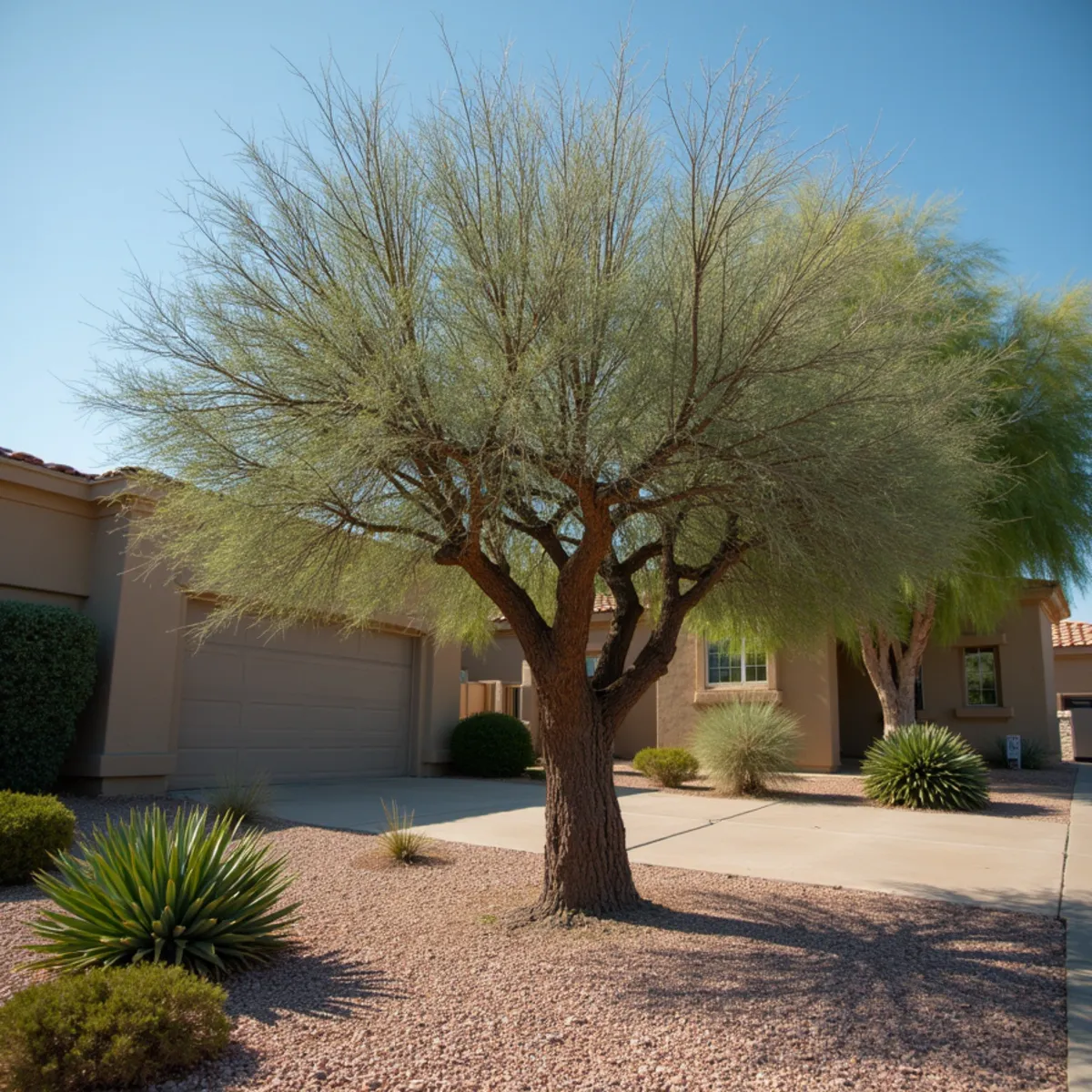
The best defense against a monsoon blow-over happens months before the storm. A dense, overgrown desert canopy catches wind like a sail, and when a 60-plus mph microburst hits, that load can uproot or snap a tree that a well-thinned canopy would have shrugged off. Crown thinning is preventive care, and it is far cheaper than an emergency takedown and a new roof.
But thinning has to be done correctly. The most common mistakes, lions-tailing and topping, actually make a tree more dangerous by stripping its interior and forcing weak, whip-like regrowth that snaps in the next storm. Good pruning follows recognized standards and removes the right wood, not the most wood.
Ecosphere Landscaping thins and structurally prunes palo verde, mesquite, ironwood and other desert species across Mesa and the East Valley, opening air windows and building strong branch structure so your trees are ready for monsoon season.

Signs your desert tree needs thinning
- A dense, sail-like canopy that whips hard in the wind
- Long, heavy branches with all the weight out at the tips
- Crossing, rubbing or crowded interior limbs
- A previous topping or lions-tail job that produced weak regrowth
- A tree that has grown lopsided or is leaning toward a structure
- Deadwood or broken limbs hanging in the canopy
- A young tree with no clear structure being trained
How thinning prevents blow-overs
Wind does not go around a dense canopy, it pushes it. By selectively removing interior branches, crown thinning creates gaps, sometimes called air windows, that let a gust pass through the tree instead of levering against the whole mass. Combined with reducing tip-heavy weight, this lowers the sail effect that topples fast-growing desert trees in monsoon downbursts. Our article on why palo verde and mesquites topple explains the wind loading in more depth.
Species matters
Palo verde, mesquite and ironwood each grow differently and need a slightly different hand. Palo verde has green bark that photosynthesizes, so careless cuts and over-thinning stress the tree. Fast-growing hybrid mesquites become top-heavy quickly and benefit from regular structural pruning. Ironwood is slow and dense and should be pruned conservatively. Knowing the species is half of pruning it well, which is why our native cacti and desert botanical plantings team and our arborists work from the same plant knowledge.
| Species | Habit | Pruning focus |
|---|---|---|
| Palo verde | Fast, green bark | Light thinning; protect bark |
| Hybrid mesquite | Fast, top-heavy | Regular structural thinning |
| Velvet mesquite | Moderate, sturdy | Structure and deadwood |
| Ironwood | Slow, dense | Conservative, minimal cuts |
Timing and follow-up
The ideal time for wind-focused thinning is before monsoon season, so the tree faces the storms with an open canopy. We avoid over-pruning during peak heat stress and we never remove healthy growth without a reason. Thinning is not a one-time event; fast-growing species need revisiting every year or two. If a storm does damage a tree before we can prune it, our emergency monsoon storm cleanup crew can respond and then set it up for healthy recovery.
- Crown thinning for wind resistance on desert species
- Structural pruning to train young trees
- Deadwood and hazard-limb removal
- Corrective pruning after previous topping or lions-tailing
- Pre-monsoon canopy preparation
How we deliver tree crown thinning
- 1
Assess the tree
We evaluate species, structure, health and the targets below the canopy to plan pruning that improves wind resistance without over-cutting.
- 2
Set the objective
We decide between structural pruning for a young tree, crown thinning for wind, or cleanup pruning to remove deadwood, and prune to that goal.
- 3
Thin selectively
We remove interior and crowded branches to open air windows so wind passes through, keeping the canopy balanced rather than stripped.
- 4
Prune to standard
We make proper cuts at the branch collar following recognized ANSI A300 pruning practice, never topping or lions-tailing.
- 5
Protect desert-specific traits
We avoid damaging the green photosynthetic bark of palo verde and time cuts to protect the tree during heat stress.
- 6
Clean up
We chip and haul all trimmings and leave the site clean, with a note on when the tree should be revisited.
What affects the cost
Every desert yard is different, so we quote from an on-site assessment — never a one-size total. These are the main factors that move your estimate:
- Size and species of the tree and the height of the canopy
- Number of trees and how overgrown or neglected they are
- Access and proximity to structures and utility lines
- Whether the job is routine thinning or corrective pruning
- Volume of trimmings to chip and haul away
- Frequency, since regular clients on a cycle prune less each visit
- Any deadwood or storm damage that must be addressed
Why Mesa homeowners choose Ecosphere for tree crown thinning
We're a locally owned, licensed and insured Arizona ROC contractor that has served the East Valley since 2017. The person who walks your yard is accountable for the crew that finishes it — no call centers, no out-of-town subs.
- 9+ years in the East Valley
- Licensed & insured
- Free estimates
- 24/7 emergency response