A: Cost & Pricing
Travertine vs Concrete Pavers for Phoenix Pool Decks: Cost & Heat
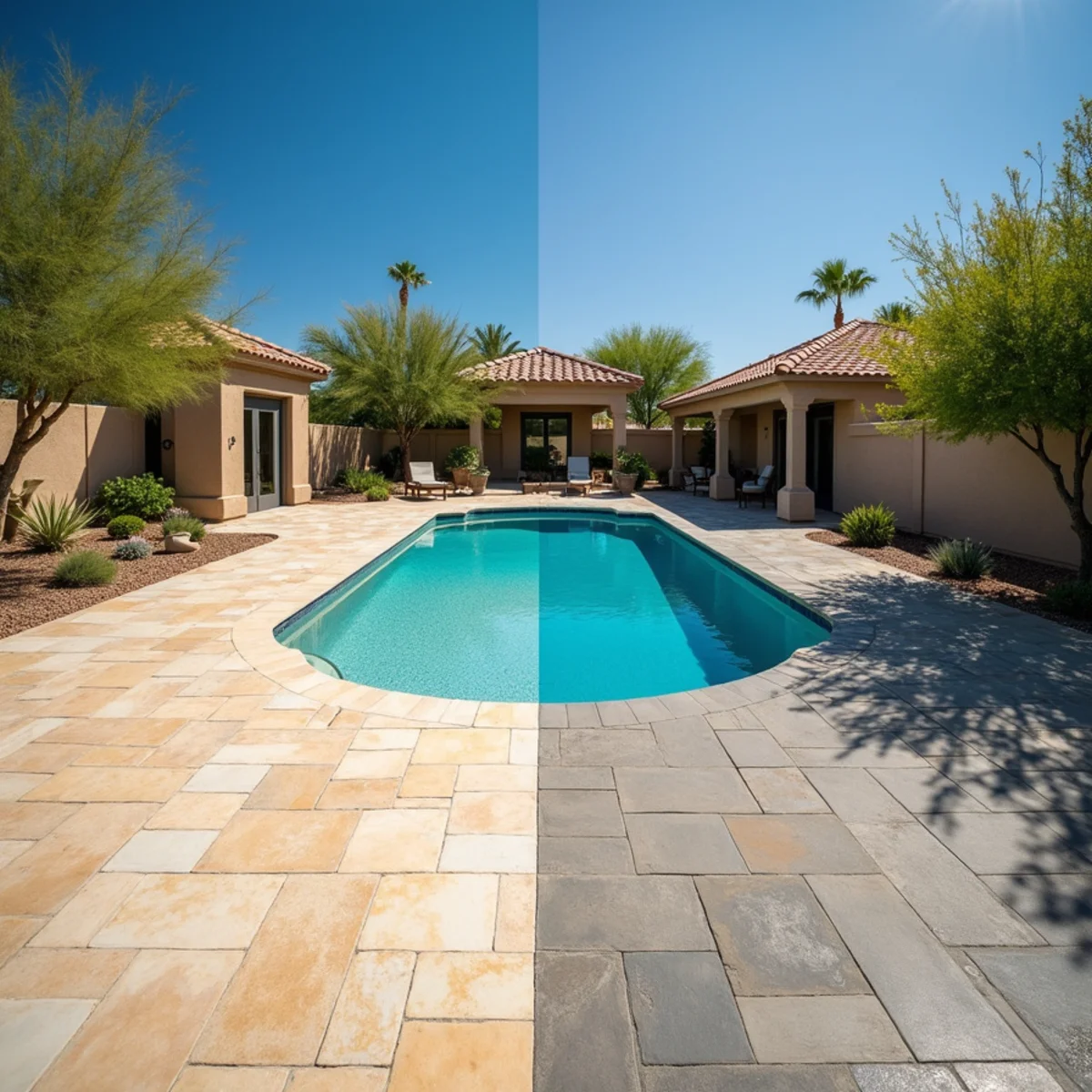
Which pool deck stays barefoot-friendly in a 115-degree Phoenix summer, travertine or concrete pavers? A cost, heat, and durability comparison built for desert conditions.
In Phoenix, a pool deck is judged first by your bare feet in July, then by your budget. Travertine and concrete pavers are the two dominant choices, and both can look spectacular, but they behave differently under brutal heat, chlorinated water, and the expansive caliche clay soils of the East Valley. This comparison sorts the marketing from the physics so you can choose the surface you will actually be able to walk on.
The 115-Degree Summer Test: Which Surface Stays Barefoot-Friendly?
Surface temperature is the deciding factor for most families, and it comes down to color and density. Travertine is a natural stone that is typically light in color, and light surfaces reflect more solar radiation, so ivory and silver travertine usually run cooler underfoot than dark pavers. Its porous structure also holds a little moisture that helps it shed heat. Concrete pavers can be manufactured in cooler light tones too, but the popular charcoal and espresso colors absorb heat and can become uncomfortable at midday.
The physics is simple: dark surfaces absorb far more of the sun's energy than light ones, and any hardscape sitting in full Phoenix sun through a July afternoon stores that heat and radiates it back at your feet. This is why a poolside patio that felt fine in April can be genuinely painful by mid-summer if the material and color were chosen for looks alone. If barefoot comfort matters to your household, treat surface temperature as a design requirement, not an afterthought, and test a sample in direct sun before you commit.
There is also a practical hedge that applies to any surface: shade. A pergola, a strategically placed shade tree, or an umbrella over the main lounging area cuts surface temperature dramatically regardless of material. Planning shade into the deck design is often the single most effective way to keep a pool area usable at midday, and it is best coordinated with the surrounding landscape rather than bolted on later.
Upfront Material and Installation Cost Differences in Arizona
Both surfaces cost more than poured concrete, and both reward proper base work. Use these Phoenix-metro planning benchmarks to frame a budget, then get a measured quote for your specific deck.
| Factor | Travertine | Concrete pavers |
|---|---|---|
| Installed cost benchmark | ~$16 – $28 / sq ft | ~$14 – $22 / sq ft |
| Barefoot heat (light colors) | Runs cooler, reflective and porous | Cooler only in light tones |
| Salt / chlorine resistance | Excellent; natural stone | Good with quality sealer |
| Repairability | Replace individual tiles | Lift and reset individual units |
| Look | Natural stone, French pattern | Uniform, many shapes and colors |
Pavers often edge out travertine on raw material price, while travertine commands a premium for the natural-stone look. In both cases, the base preparation is where a deck is won or lost, and where cutting corners shows up within a couple of years. Be cautious of any bid that comes in far below these ranges; the savings usually come out of the excavation and base, which is exactly the part you cannot see and cannot easily fix later.
Remember to price the whole project, not just the deck field. Edge restraints, coping around the pool, cutting around curves and steps, demolition of any existing surface, and drainage all add to the total. A written estimate should itemize these so you are comparing complete scopes rather than a low square-foot number that quietly excludes the finish work.
Chlorine and Saltwater Pool Resistance of Travertine Tile
Saltwater pools have grown popular in Arizona, and salt is hard on the wrong materials. Travertine is naturally resistant to salt and chlorine and does not require sealing to survive pool chemistry, though many owners seal it anyway to resist staining. Concrete pavers hold up well too, but they benefit from a quality penetrating sealer to guard against efflorescence and salt spalling over time. Either way, rinsing splash-out and keeping pool chemistry balanced extends the life of the deck.
Base Compaction in Expansive Desert Caliche Clay Soils
This is the part no glossy brochure mentions. The East Valley sits over caliche and clay-heavy ground that expands and contracts with moisture, and that movement is what cracks poorly built decks. A durable paver or travertine deck needs a properly excavated and compacted aggregate base, correct edge restraint, and drainage that carries monsoon water away from the pool shell. Where caliche is encountered during excavation, it has to be broken out to reach stable subgrade, which is exactly the kind of work our caliche soil breaking and trenching crew handles.
Proper base work follows a sequence: excavate to the right depth, break through any caliche that prevents reaching stable ground, lay and compact aggregate base in lifts, set a bedding layer, then place the units and lock them in with edge restraint and joint material. Compaction in lifts matters because a thick layer dropped all at once never densifies fully and settles unevenly later. Drainage is planned at the same time, since monsoon water pooling under a deck is a leading cause of the shifting that ruins it. This is unglamorous work, but it is the difference between a deck that stays flat for decades and one that heaves within a few summers.
Slip Resistance, Maintenance, and Longevity
Around a pool, traction matters as much as temperature. Tumbled travertine has a naturally textured, matte surface that provides good grip when wet, one reason it is so popular for pool surrounds. Concrete pavers vary; a textured or shot-blasted finish grips well, while a smooth, heavily sealed paver can get slick. Ask about the finish and slip rating, not just the color, when you choose.
On maintenance, both materials are unit systems, which is a real long-term advantage over a poured slab. If a section settles, stains, or a single piece chips, that piece can be lifted and reset or swapped without demolishing the whole deck. Travertine benefits from occasional resealing to resist staining, and pavers benefit from periodic joint-sand replenishment and sealing to lock everything in place and limit efflorescence. Neither is demanding, but both reward a light touch of upkeep every few years.
Which Should You Choose?
There is no universal winner; the right surface depends on how you weigh a handful of trade-offs. Use these guidelines to narrow it down before you get quotes.
- Choose travertine if you want a natural-stone look, a naturally cool and grippy surface, and effortless saltwater-pool resistance, and the premium fits your budget.
- Choose concrete pavers if you want the widest range of shapes, colors, and patterns, tighter control of cost, and easy matching to walkways and driveways.
- For the coolest deck either way, commit to a light color and build in shade over the main lounging area.
- For the most durable deck either way, spend on excavation, caliche removal, base compaction, and drainage rather than on upgrading the surface over a weak base.
Aesthetic Luxury: French Pattern Travertine vs Interlocking Pavers
Design intent often makes the final call. Travertine laid in a French pattern, a repeating mix of four tile sizes, reads as a high-end natural stone terrace and pairs beautifully with desert plantings. Interlocking concrete pavers offer more shapes, colors, and geometric patterns, and they make it easy to weave in borders, banding, and matching walkways. A cohesive deck is easier to achieve when the hardscape is planned alongside the surrounding yard; our paver patios and travertine pool decks service designs the deck and the landscape together, and our desert landscape design and xeriscaping team ties in the plantings that frame it.
Request a Custom Pool Deck Estimate from Our Hardscape Team
The right answer depends on your color preference, budget, pool chemistry, and how your specific soil behaves. We assess all four on site. Ecosphere Landscaping has built and repaired pool decks across Mesa, Gilbert, and Paradise Valley, and we are locally owned, licensed, and insured.
Call (323) 606-0255 to schedule a pool deck consultation and get a written, benchmark-based estimate for travertine or pavers built on a base that survives desert soil.
Talk to a local desert landscaping expert
Serving Mesa & the East Valley since 2017. Get honest, itemized pricing and water-smart advice for your specific yard.
Frequently asked questions
In matching light colors, travertine usually runs slightly cooler because it is reflective and porous, but color is the biggest factor. A light paver stays far cooler than a dark travertine, so choose the shade first.
As a planning benchmark, installed travertine runs roughly $16 to $28 per square foot and concrete pavers about $14 to $22, with base preparation and site access driving the final figure.
Yes. Travertine is naturally resistant to salt and chlorine. Concrete pavers also perform well, especially with a quality penetrating sealer to prevent efflorescence and spalling.
Expansive clay and caliche soils move with moisture. Decks fail when the base is not properly excavated, compacted, and drained. Unit systems like pavers and travertine tolerate movement better than a poured slab.
Related services & areas
Service areas